# Trigger incident.io Incidents

## incident.io Integration

Connect incident.io to Paradime to automatically create incidents when Bolt runs fail, with Slack-native collaboration and automated incident workflows.

{% hint style="info" %}
**Need to connect incident.io first?** Follow our [incident.io integration](https://docs.paradime.io/app-help/documentation/integrations/incident-management/incident.io) setup guide to authenticate and connect your account.
{% endhint %}

### Configure incident.io Trigger

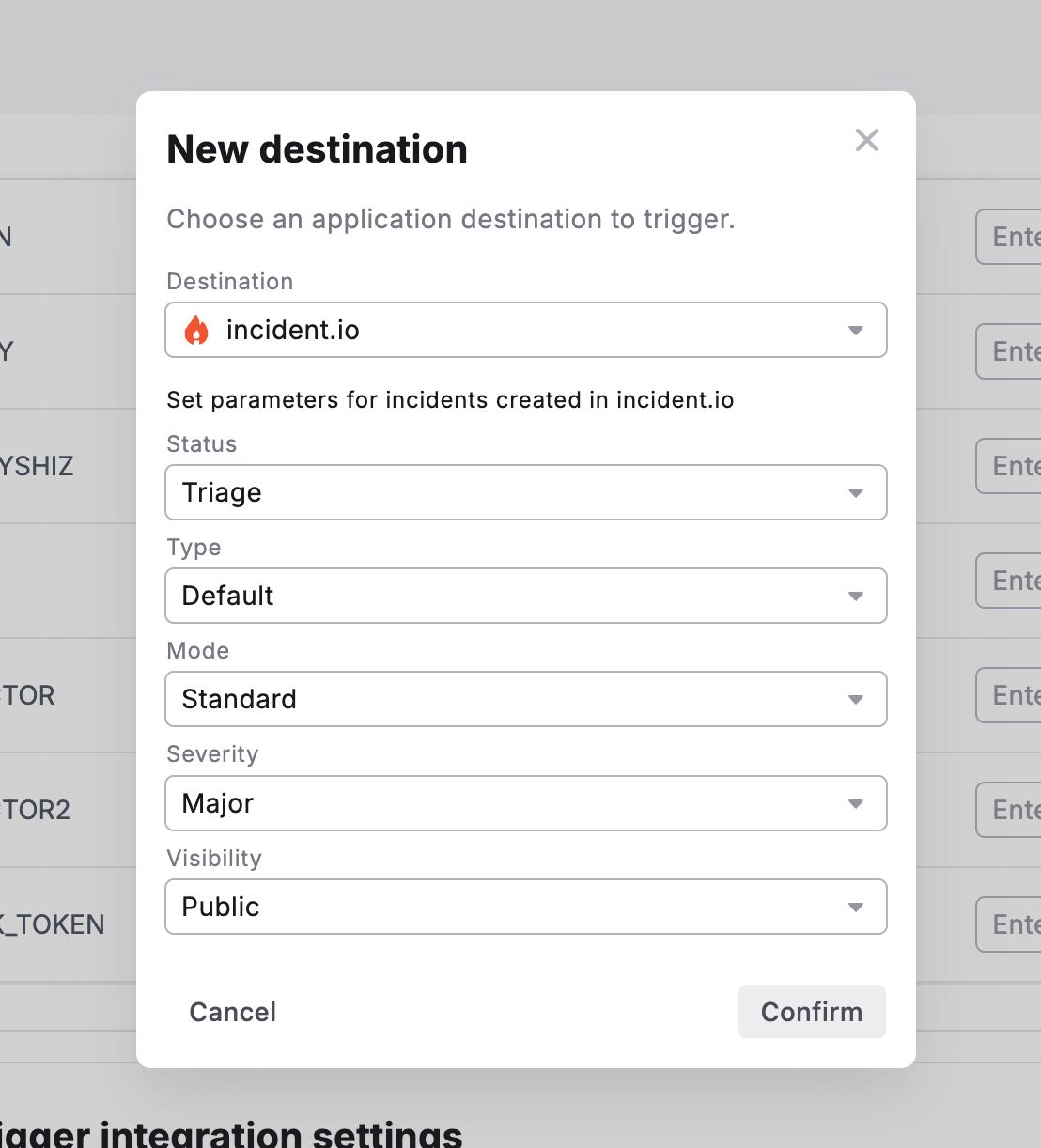
#### Step 1: Add incident.io Destination

1. Navigate to the **Triggers integration** section
2. Click **Add Integration**
3. Select **incident.io** from the dropdown

<div data-with-frame="true"><figure><img src="https://2337193041-files.gitbook.io/~/files/v0/b/gitbook-x-prod.appspot.com/o/spaces%2FHET0AD04uHMgdeLAjptq%2Fuploads%2FaEjoTUfXjZnr4cAaTz2l%2Fimage.png?alt=media&#x26;token=de5e30f9-da8a-423c-a7e3-4b83f03023b4" alt="" width="375"><figcaption></figcaption></figure></div>

#### Step 2: Set Incident Parameters

Configure the following fields to customize incidents created in incident.io:

| Field          | Description                          | Options                                           |
| -------------- | ------------------------------------ | ------------------------------------------------- |
| **Status**     | Initial status for created incidents | Merged, Declined, Canceled, Active, Resolved      |
| **Type**       | Incident type classification         | Default, or custom types from incident.io         |
| **Mode**       | Incident creation mode               | Retrospective, Standard, Tutorial                 |
| **Severity**   | Priority level for pipeline failures | Minor, Major, Critical, or custom severity levels |
| **Visibility** | Who can see the incident             | Public (anyone in Slack), Private (invite-only)   |

#### Step 3: Confirm Configuration

1. Review your incident parameters
2. Click **Confirm** to save the trigger
3. The incident.io trigger is now active for this schedule

### What Gets Created

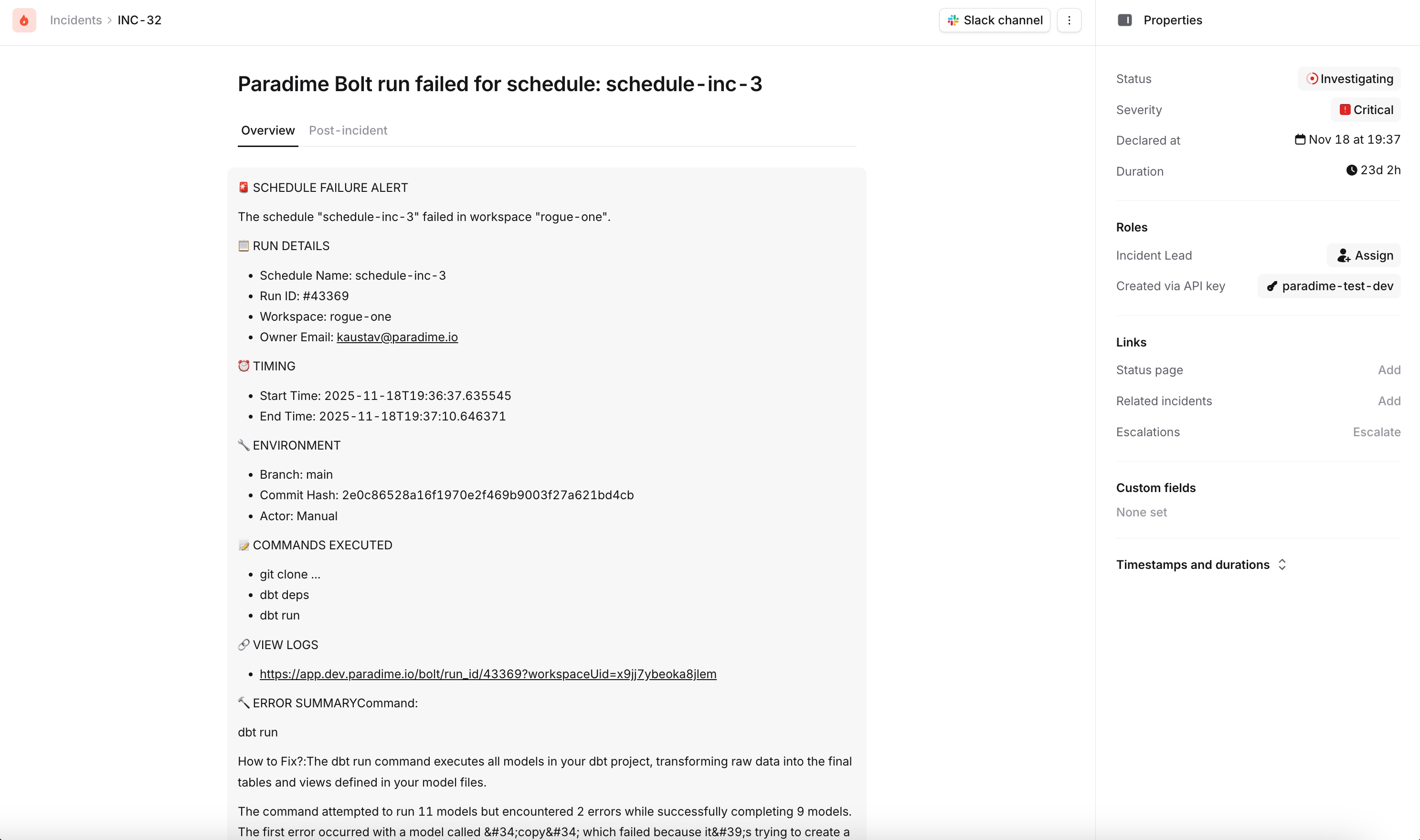
When a Bolt run fails, incident.io will automatically create an incident containing:

* Incident name with schedule and workspace details
* Incident summary including:
  * Direct link to Paradime run logs
  * Run ID and execution details
  * Start and end timestamps
  * Commands executed
  * Branch information
  * AI Summary of the command Logs
* Configured severity level, type, and mode
* Automatic Slack channel creation (if visibility is Public)
<div data-with-frame="true"><figure><img src="https://2337193041-files.gitbook.io/~/files/v0/b/gitbook-x-prod.appspot.com/o/spaces%2FHET0AD04uHMgdeLAjptq%2Fuploads%2FQ50UWPCqz7vQc8psNX8r%2Fimage.png?alt=media&#x26;token=073ae9c9-0380-49c5-9b5c-2efa2cae3b14" alt=""><figcaption></figcaption></figure></div>

### Testing Your Configuration

1. Manually run a schedule that will fail
2. Check your incident.io dashboard for the new incident
3. Verify the incident contains the correct parameters and run details
4. Confirm the Slack channel was created (if applicable)

### Key Benefits

* **Slack-native collaboration** - Manage incidents directly in Slack with automatic channel creation
* **Standardized workflows** - Leverage incident.io's battle-tested incident response processes
* **Automatic documentation** - Timeline and postmortem features for pipeline issues
* **Integration with on-call** - Automatically page the right team when critical pipelines fail


---

# Agent Instructions: Querying This Documentation

If you need additional information that is not directly available in this page, you can query the documentation dynamically by asking a question.

Perform an HTTP GET request on the current page URL with the `ask` query parameter:

```
GET https://docs.paradime.io/app-help/documentation/bolt/creating-schedules/trigger-integrations/trigger-incident.io-incidents.md?ask=<question>
```

The question should be specific, self-contained, and written in natural language.
The response will contain a direct answer to the question and relevant excerpts and sources from the documentation.

Use this mechanism when the answer is not explicitly present in the current page, you need clarification or additional context, or you want to retrieve related documentation sections.