# BigQuery

{% hint style="warning" %}
**IP RESTRICTIONS**

Make sure to allow traffic from one of the Paradime IPs in your firewall depending on the data location selected.

👉 See also: [Paradime IP addresses](https://docs.paradime.io/app-help/developers/ip-restrictions).
{% endhint %}

{% hint style="info" %}
We recommend creating a dedicated BigQuery service account for the DinoAI agent environment, with the minimum permissions required to create tables and views in your BigQuery project.
{% endhint %}

### Create a service account

To create a service account in BigQuery, follow the detailed steps in [Google Cloud's Creating and managing service account keys](https://cloud.google.com/iam/docs/creating-managing-service-account-keys#iam-service-account-keys-delete-console).

#### Required permissions

This set of permissions will enable DinoAI to read from and create tables and views during background agent sessions in your BigQuery project.

```
BigQuery Data Editor
BigQuery User
```

### Add the DinoAI agent environment connection

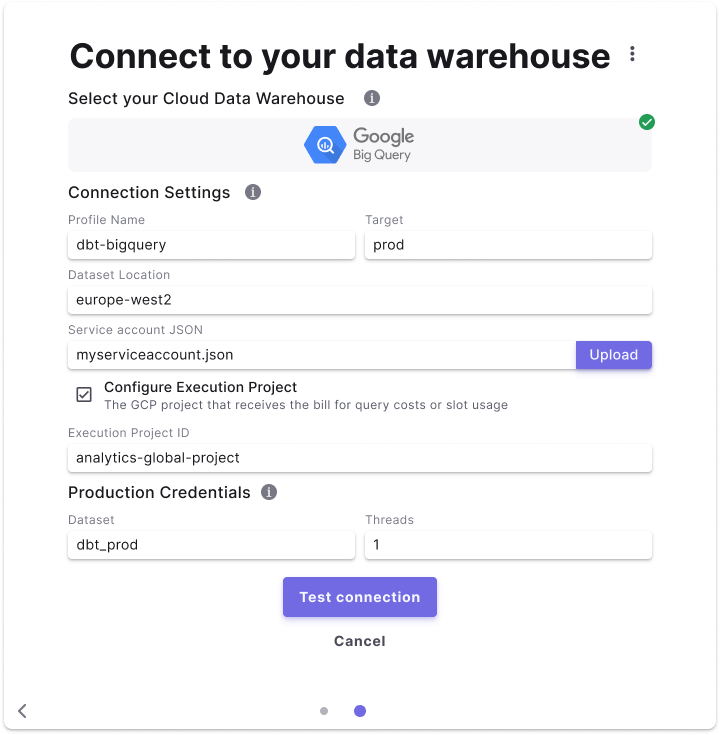
To add the BigQuery DinoAI agent environment connection, follow these instructions:

1. Click **Settings** in the top menu bar of the Paradime interface to access **Account Settings**
2. In the left sidebar, click **Connections**
3. Click **Add New** next to the **DinoAI Background Agent Environment** section
4. Select **BigQuery**

<figure><img src="https://2337193041-files.gitbook.io/~/files/v0/b/gitbook-x-prod.appspot.com/o/spaces%2FHET0AD04uHMgdeLAjptq%2Fuploads%2F57ntB5vIQ6b2jJEn2PQL%2Fprod_connection_bigquery_sajson.png?alt=media&#x26;token=1a0a11de-d5a6-48c8-895f-769f14675e79" alt="" width="540"><figcaption></figcaption></figure>

#### Field details

<table><thead><tr><th width="180">Field</th><th width="352">Description</th><th>Example</th></tr></thead><tbody><tr><td>Profile Name</td><td>The profile name set in your <code>dbt_project.yaml</code>. See more <a href="https://docs.getdbt.com/docs/core/connect-data-platform/connection-profiles">here</a>.</td><td><strong><code>dbt-bigquery</code></strong></td></tr><tr><td>Target</td><td>The target name used to identify the DinoAI agent environment connection. See more <a href="https://docs.getdbt.com/reference/dbt-jinja-functions/target">here</a>.</td><td><strong><code>dinoai</code></strong></td></tr><tr><td>Dataset Location</td><td>The location of BigQuery datasets. Can be a multi-regional location (e.g. <code>EU</code>, <code>US</code>) or a regional location (e.g. <code>europe-west2</code>). See more <a href="https://cloud.google.com/bigquery/docs/locations">here</a>.</td><td><strong><code>US</code></strong></td></tr><tr><td>Service Account JSON</td><td>The service account JSON file created for the DinoAI agent service user.</td><td><strong><code>service_account_dinoai.json</code></strong></td></tr><tr><td>Execution Project ID (Optional)</td><td>Specify an execution project to bill for query execution, instead of the project where you materialise your resources. See more <a href="https://docs.getdbt.com/docs/core/connect-data-platform/bigquery-setup#execution-project">here</a>.</td><td><strong><code>analytics-global-project</code></strong></td></tr><tr><td>Dataset</td><td>The default dataset used to build dbt™ objects during DinoAI background agent sessions.</td><td><strong><code>dbt_dinoai</code></strong></td></tr><tr><td>Threads</td><td>The number of threads used in this connection. See more <a href="https://docs.getdbt.com/docs/running-a-dbt-project/using-threads">here</a>.</td><td><strong><code>8</code></strong></td></tr></tbody></table>


---

# Agent Instructions: Querying This Documentation

If you need additional information that is not directly available in this page, you can query the documentation dynamically by asking a question.

Perform an HTTP GET request on the current page URL with the `ask` query parameter:

```
GET https://docs.paradime.io/app-help/documentation/settings/connections/dinoai-background-agent-environment/bigquery.md?ask=<question>
```

The question should be specific, self-contained, and written in natural language.
The response will contain a direct answer to the question and relevant excerpts and sources from the documentation.

Use this mechanism when the answer is not explicitly present in the current page, you need clarification or additional context, or you want to retrieve related documentation sections.