> ## Documentation Index
> Fetch the complete documentation index at: https://docs.paradime.io/llms.txt
> Use this file to discover all available pages before exploring further.
# Column-level lineage for agents, and for the copilot
> Programmable, Slack and Bolt agents can now trace a column. The copilot and MCP tool moved onto Paradime's own lineage graph, with depth controls.
*September 22, 2026*
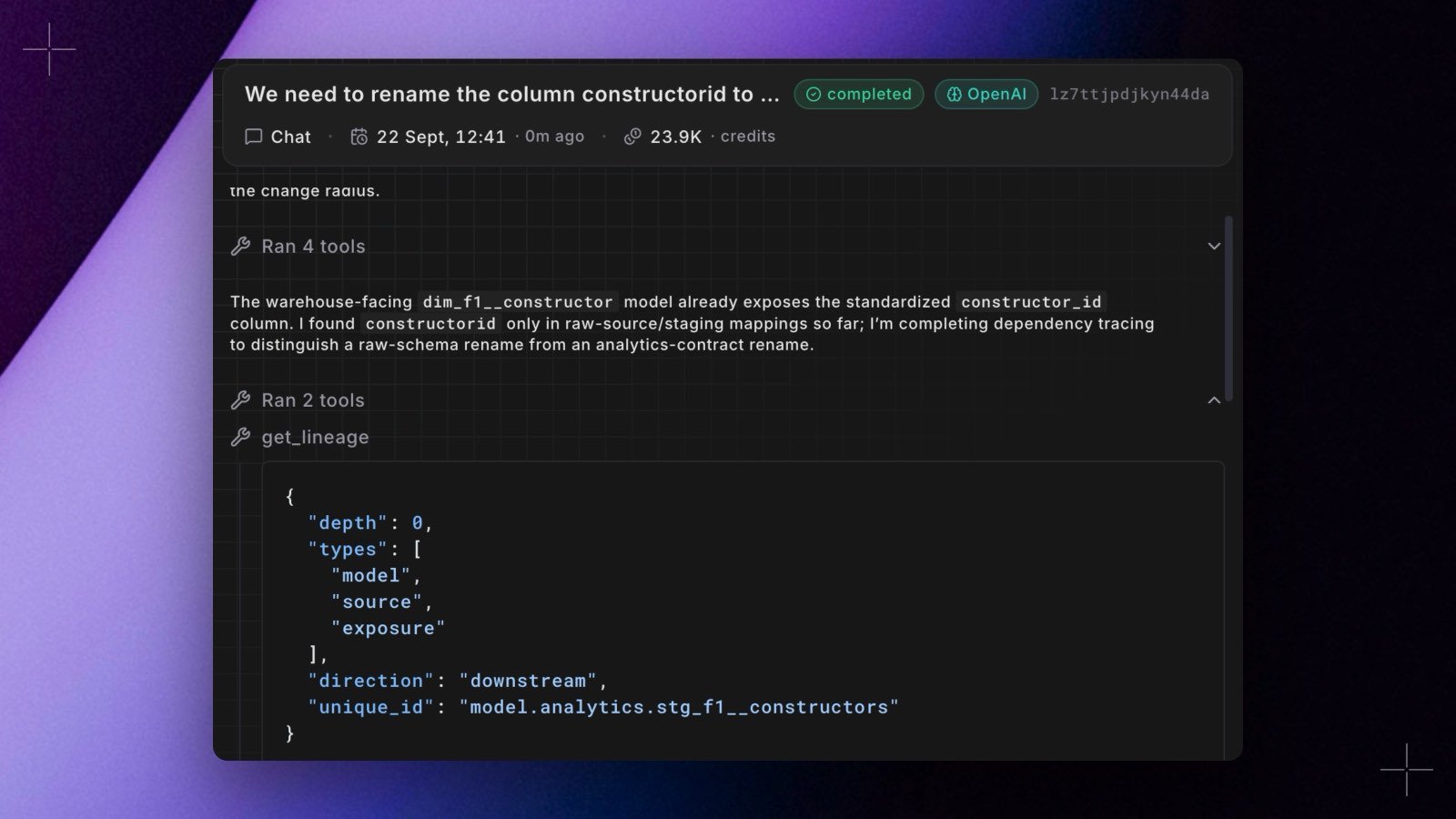 `get_column_level_lineage` was a copilot-only tool that called a separate service and handed the raw response to the model. It now runs on the same lineage graph the [Catalog](/products/data-catalog/lineage/column-level-lineage) draws from, and it is available to agents for the first time.
**Agents can trace a column**
Programmable agents, the [Slack agent](/products/dino-ai/slack-agent/index) and Bolt agents had no column-level tool at all: their only lineage tool worked at model grain. Ask a Slack-triggered agent "what breaks if I change `orders.amount`?" and it can now answer. The tool sits in a new **Lineage** group in the agent builder, so allowlisted agents can pick it up.
**A better answer, for fewer tokens**
* **Scope follows your workspace**, covering the production environment plus connected integrations and dbt Mesh, rather than production alone.
* **Depth is yours to set.** `upstream_depth` and `downstream_depth` default to 2 and cap at 10, and an answer is capped at 150 nodes and 400 edges with a message telling the agent how to narrow rather than a silent truncation.
* **The payload is built for a model, not a canvas.** Logos, colours and provider glyphs are gone. An edge carries where the value came from, where it went, how it was transformed, and the expression that did it.
* **The 60 second timeout is gone** as a failure mode, along with the service behind it.
**It says when it cannot answer**
The four ways a trace can come up empty no longer collapse into one vague reply, because the right next step differs for each. An ambiguous model name lists the candidates with their projects, a near miss suggests the name it thinks you meant, and a column the catalog has no record of is called out rather than quietly answered at table grain.
The one that matters most: when no lineage has been built yet, the tool says so explicitly, and that this is **not** the same as the column having no dependencies. Nodes whose SQL only partly parsed carry that status too, so a gap in the graph is never presented as a finished answer.
See [Column Level Lineage](/products/dino-ai/tools-and-features/column-level-lineage), the [Tools Reference](/products/dino-ai/programmable-agents/tools-reference), and the [MCP server](/products/dino-ai/mcp-server/index). Shipped in Paradime v6.13.0.
## Related topics
- [Column Level Lineage](/products/dino-ai/tools-and-features/column-level-lineage.md)
- [Column-level lineage in the Catalog](/changelog/2026-09-03/column-level-lineage.md)
- [Column-level lineage](/products/data-catalog/lineage/column-level-lineage.md)
- [Column-Level Lineage Diff](/products/bolt/ci-cd/lineage-diff/index.md)
- [Column-Level Lineage Diff for Looker](/products/bolt/ci-cd/lineage-diff/looker.md)
`get_column_level_lineage` was a copilot-only tool that called a separate service and handed the raw response to the model. It now runs on the same lineage graph the [Catalog](/products/data-catalog/lineage/column-level-lineage) draws from, and it is available to agents for the first time.
**Agents can trace a column**
Programmable agents, the [Slack agent](/products/dino-ai/slack-agent/index) and Bolt agents had no column-level tool at all: their only lineage tool worked at model grain. Ask a Slack-triggered agent "what breaks if I change `orders.amount`?" and it can now answer. The tool sits in a new **Lineage** group in the agent builder, so allowlisted agents can pick it up.
**A better answer, for fewer tokens**
* **Scope follows your workspace**, covering the production environment plus connected integrations and dbt Mesh, rather than production alone.
* **Depth is yours to set.** `upstream_depth` and `downstream_depth` default to 2 and cap at 10, and an answer is capped at 150 nodes and 400 edges with a message telling the agent how to narrow rather than a silent truncation.
* **The payload is built for a model, not a canvas.** Logos, colours and provider glyphs are gone. An edge carries where the value came from, where it went, how it was transformed, and the expression that did it.
* **The 60 second timeout is gone** as a failure mode, along with the service behind it.
**It says when it cannot answer**
The four ways a trace can come up empty no longer collapse into one vague reply, because the right next step differs for each. An ambiguous model name lists the candidates with their projects, a near miss suggests the name it thinks you meant, and a column the catalog has no record of is called out rather than quietly answered at table grain.
The one that matters most: when no lineage has been built yet, the tool says so explicitly, and that this is **not** the same as the column having no dependencies. Nodes whose SQL only partly parsed carry that status too, so a gap in the graph is never presented as a finished answer.
See [Column Level Lineage](/products/dino-ai/tools-and-features/column-level-lineage), the [Tools Reference](/products/dino-ai/programmable-agents/tools-reference), and the [MCP server](/products/dino-ai/mcp-server/index). Shipped in Paradime v6.13.0.
## Related topics
- [Column Level Lineage](/products/dino-ai/tools-and-features/column-level-lineage.md)
- [Column-level lineage in the Catalog](/changelog/2026-09-03/column-level-lineage.md)
- [Column-level lineage](/products/data-catalog/lineage/column-level-lineage.md)
- [Column-Level Lineage Diff](/products/bolt/ci-cd/lineage-diff/index.md)
- [Column-Level Lineage Diff for Looker](/products/bolt/ci-cd/lineage-diff/looker.md)