> ## Documentation Index
> Fetch the complete documentation index at: https://docs.paradime.io/llms.txt
> Use this file to discover all available pages before exploring further.
# Copy a connection to another environment
> Copy a data warehouse connection, secrets included, into another Bolt or Agent environment or the Code IDE, then review and test it before it saves.
Copy an existing warehouse connection when you add an environment, instead of typing every setting and secret again. The copy is a new connection, and the original stays as it is.
**Prerequisites**
* An Admin, Workspace Admin, or Workspace Settings Admin [role](/products/settings/users/index).
* A saved connection to copy. Radar cost connections can't be copied.
Estimated time: 2 minutes.
## Steps
Go to **Settings**, then **Environments**. On the connection you want to copy, click the copy icon next to **View**. From a connection's own page, select the **More (...)** menu, then **Copy to another environment**. The menu item is hidden while you edit the connection.
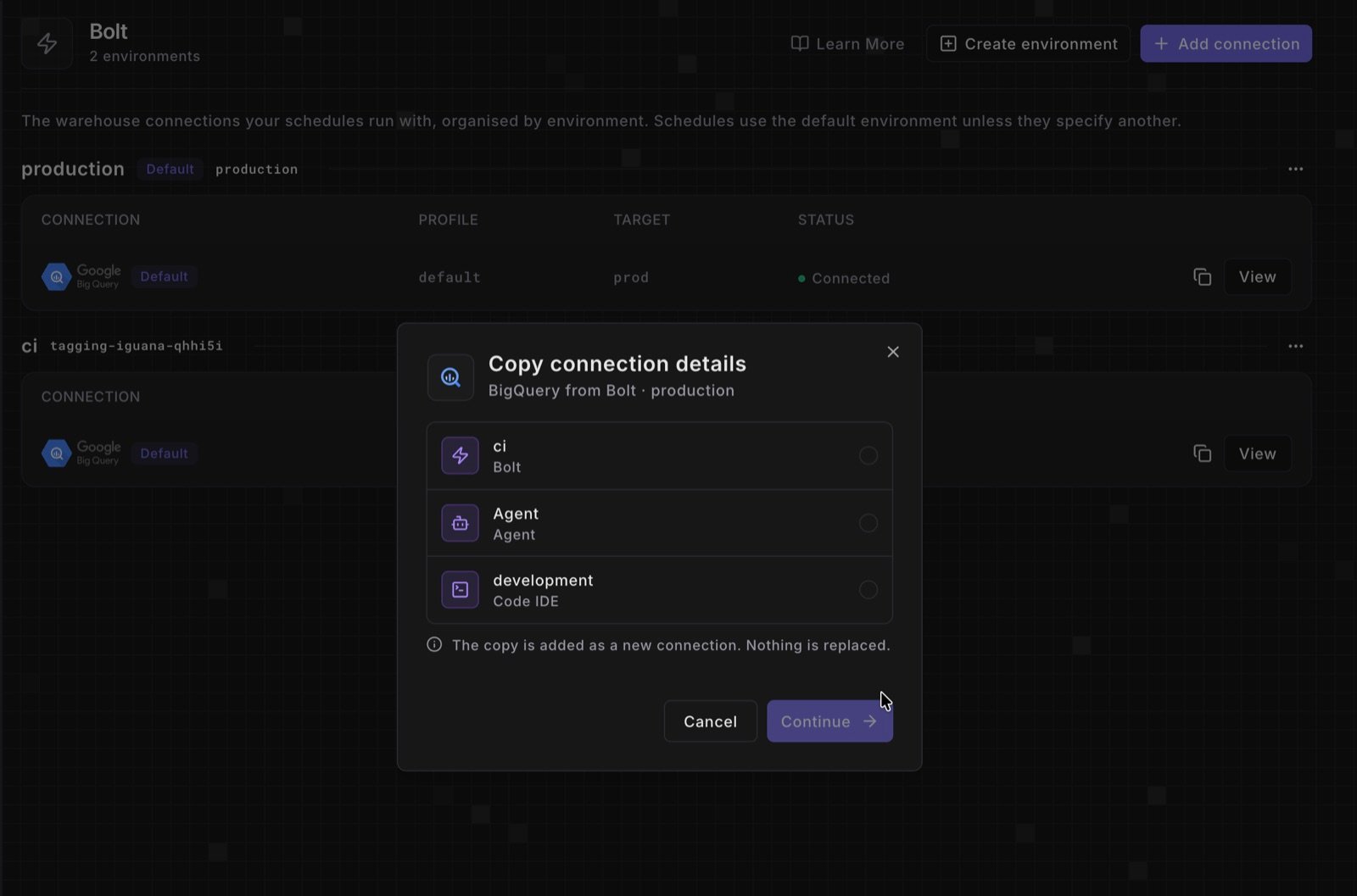
In **Copy connection details**, choose another Bolt or Agent environment, or Code IDE, and click **Continue**. If the target already has a connection, the copy is added next to it and doesn't replace it.
 The target's new-connection form opens under a **Copied from** note, with the source's settings and secrets filled in. Fill in anything left empty, check the schema, database, and target, then click **Test Connection**. The copy saves when the test passes.
The copied connection shows in the target environment's list in **Settings** > **Environments**. If the test fails, compare the schema, database, and target with the source connection, and enter again any secret the form left empty.
## What doesn't copy as it is
* **Auth methods the target doesn't offer.** Bolt and Agent environments don't offer Snowflake OAuth, BigQuery OAuth, or Redshift IAM. A copy of such a connection starts from a method they do offer (the form's default for Snowflake, a service account for BigQuery, username and password for Redshift) with those credentials empty. For Redshift IAM, the host, port, and database start empty too.
* **MotherDuck tokens.** Paradime never returns a stored token, so enter it again.
* **Secrets that can't be read.** The note turns amber and asks you to enter them again.
* **Code IDE credentials.** They belong to you. Copying from the Code IDE copies your own credentials as they are.
## Next steps
Make the copy the environment's default connection.
How environments and their connections fit together.
## Related topics
- [Copy a warehouse connection to another environment](/changelog/2026-10-16/copy-a-connection.md)
- [Manage connections](/guides/data-warehouse-essentials/manage-connections/index.md)
- [Changelog](/changelog/overview.md)
- [Connect your data warehouse to each environment](/products/settings/connections/index.md)
- [July 28 improvements: Bolt, Slack agent, Catalog](/changelog/2026-07-28/other-improvements.md)
This documentation is built and hosted on [Mintlify](https://mintlify.com), a developer documentation platform.
The target's new-connection form opens under a **Copied from** note, with the source's settings and secrets filled in. Fill in anything left empty, check the schema, database, and target, then click **Test Connection**. The copy saves when the test passes.
The copied connection shows in the target environment's list in **Settings** > **Environments**. If the test fails, compare the schema, database, and target with the source connection, and enter again any secret the form left empty.
## What doesn't copy as it is
* **Auth methods the target doesn't offer.** Bolt and Agent environments don't offer Snowflake OAuth, BigQuery OAuth, or Redshift IAM. A copy of such a connection starts from a method they do offer (the form's default for Snowflake, a service account for BigQuery, username and password for Redshift) with those credentials empty. For Redshift IAM, the host, port, and database start empty too.
* **MotherDuck tokens.** Paradime never returns a stored token, so enter it again.
* **Secrets that can't be read.** The note turns amber and asks you to enter them again.
* **Code IDE credentials.** They belong to you. Copying from the Code IDE copies your own credentials as they are.
## Next steps
Make the copy the environment's default connection.
How environments and their connections fit together.
## Related topics
- [Copy a warehouse connection to another environment](/changelog/2026-10-16/copy-a-connection.md)
- [Manage connections](/guides/data-warehouse-essentials/manage-connections/index.md)
- [Changelog](/changelog/overview.md)
- [Connect your data warehouse to each environment](/products/settings/connections/index.md)
- [July 28 improvements: Bolt, Slack agent, Catalog](/changelog/2026-07-28/other-improvements.md)
This documentation is built and hosted on [Mintlify](https://mintlify.com), a developer documentation platform.