> ## Documentation Index
> Fetch the complete documentation index at: https://docs.paradime.io/llms.txt
> Use this file to discover all available pages before exploring further.
# PostgreSQL
> Integrate PostgreSQL with Paradime to enable dbt™ development
PostgreSQL is an open-source relational database system known for its reliability and feature robustness. As a development environment in Paradime, PostgreSQL enables dbt™️ development from Paradime's **Code IDE**.
**IP RESTRICTIONS**
Make sure to allow traffic from one of the Paradime IPs in your firewall depending on the data location selected.
👉 See also: [Paradime IP addresses](/developers/ip-restrictions).
### Setup Instructions
1. Click **Settings** in the top menu bar of the Paradime interface to access **Account Settings**
2. In the left sidebar, click "**Connections**"
3. Click "**Add New**" next to the Code IDE section
4. Select "**PostgreSQL**"
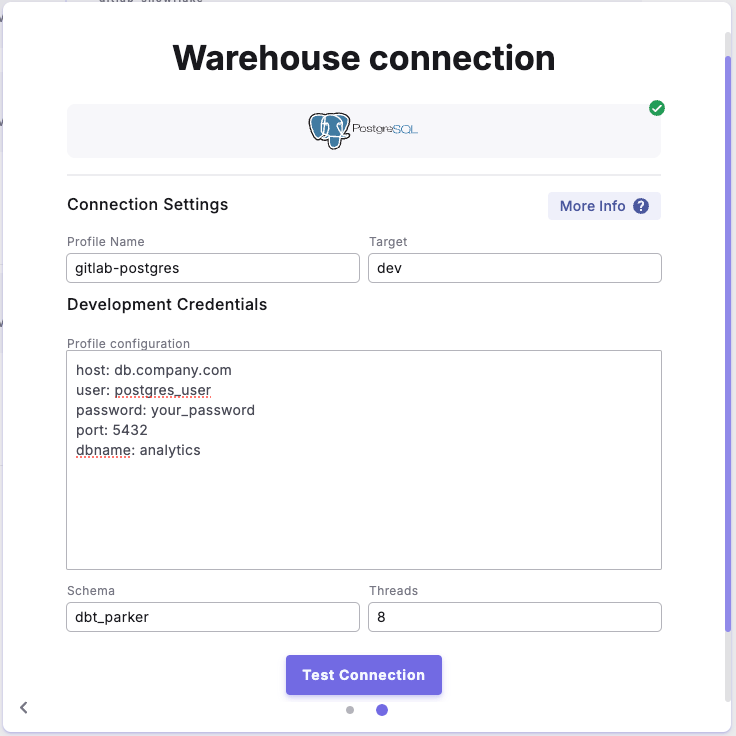
5. In the **Profile Configuration** field, add at least these required parameters. For additional configuration options, see the [Profile Fields Reference](/products/settings/connections/development-environment/postgresql#profile-fields-reference) section.
```yaml theme={"system"}
host: analytics-db.company.com # Database host
port: 5432 # Connection port
user: analytics_user # Database user
password: **** # User password
database: analytics_prod # Production database
schema: dbt # Default schema
```
After adding the configuration, ensure it's properly formatted using a YAML formatter like [YAML Formatter](https://jsonformatter.org/yaml-formatter).
6. Provide a dbt™ **Profile Name** (This should match with the profile name set in your `dbt_project.yml`).
7. In the **Target** field, enter "**dev**". This is the default target your dbt project will use for development work.
8. The "**Schema**" field is pre-configured, but you can change it to specify the schema where dbt will build objects.
9. The "**Threads**" value is pre-configured to 1, but you can adjust this number to specify how many parallel operations your dbt project can run.
***
### Example Profile Configuration
 ***
### Profile Fields Reference
| Field | Description | Example | Default Value | Required |
| ---------------- | ----------------------------------------------------------------------------- | ------------------- | -------------- | -------- |
| host | Database server hostname or IP address | `db.company.com` | None | ✅ |
| user | PostgreSQL authentication username | `postgres_user` | None | ✅ |
| password | User authentication password | `your_password` | None | ✅ |
| port | PostgreSQL server port number | `5432` | `5432` | ✅ |
| dbname | Name of the target database | `analytics` | None | ✅ |
| schema | Name of the target schema.This is configured in the UI "Schema" field | `public` | `public` | ✅ |
| threads | Number of concurrent operations. This is configured in the UI "Threads" field | `4` | `1` | ✅ |
| keepalives\_idle | Time in seconds between connection keepalive pings | `60` | `0` | ❌ |
| connect\_timeout | Seconds to wait for connection establishment | `10` | `10` | ❌ |
| retries | Number of times to retry failed connections | `3` | `1` | ❌ |
| search\_path | Order of schemas Postgres will search through | `public , prod` | `$user,public` | ❌ |
| role | PostgreSQL role to assume when executing queries | `analytics_role` | None | ❌ |
| sslmode | Level of SSL connection security | `verify-full` | `prefer` | ❌ |
| sslcert | Path to client SSL certificate file | `/path/to/cert` | None | ❌ |
| sslkey | Path to client SSL private key file | `/path/to/key` | None | ❌ |
| sslrootcert | Path to SSL root certificate authority file | `/path/to/root.crt` | None | ❌ |
## Related topics
- [PostgreSQL](/products/settings/connections/dinoai-background-agent-environment/postgresql.md)
- [Scheduler environment](/products/settings/connections/scheduler-environment/index.md)
- [DinoAI Background Agent environment](/products/settings/connections/dinoai-background-agent-environment/index.md)
- [Code IDE environment](/products/settings/connections/development-environment/index.md)
***
### Profile Fields Reference
| Field | Description | Example | Default Value | Required |
| ---------------- | ----------------------------------------------------------------------------- | ------------------- | -------------- | -------- |
| host | Database server hostname or IP address | `db.company.com` | None | ✅ |
| user | PostgreSQL authentication username | `postgres_user` | None | ✅ |
| password | User authentication password | `your_password` | None | ✅ |
| port | PostgreSQL server port number | `5432` | `5432` | ✅ |
| dbname | Name of the target database | `analytics` | None | ✅ |
| schema | Name of the target schema.This is configured in the UI "Schema" field | `public` | `public` | ✅ |
| threads | Number of concurrent operations. This is configured in the UI "Threads" field | `4` | `1` | ✅ |
| keepalives\_idle | Time in seconds between connection keepalive pings | `60` | `0` | ❌ |
| connect\_timeout | Seconds to wait for connection establishment | `10` | `10` | ❌ |
| retries | Number of times to retry failed connections | `3` | `1` | ❌ |
| search\_path | Order of schemas Postgres will search through | `public , prod` | `$user,public` | ❌ |
| role | PostgreSQL role to assume when executing queries | `analytics_role` | None | ❌ |
| sslmode | Level of SSL connection security | `verify-full` | `prefer` | ❌ |
| sslcert | Path to client SSL certificate file | `/path/to/cert` | None | ❌ |
| sslkey | Path to client SSL private key file | `/path/to/key` | None | ❌ |
| sslrootcert | Path to SSL root certificate authority file | `/path/to/root.crt` | None | ❌ |
## Related topics
- [PostgreSQL](/products/settings/connections/dinoai-background-agent-environment/postgresql.md)
- [Scheduler environment](/products/settings/connections/scheduler-environment/index.md)
- [DinoAI Background Agent environment](/products/settings/connections/dinoai-background-agent-environment/index.md)
- [Code IDE environment](/products/settings/connections/development-environment/index.md)