

Create Service Token
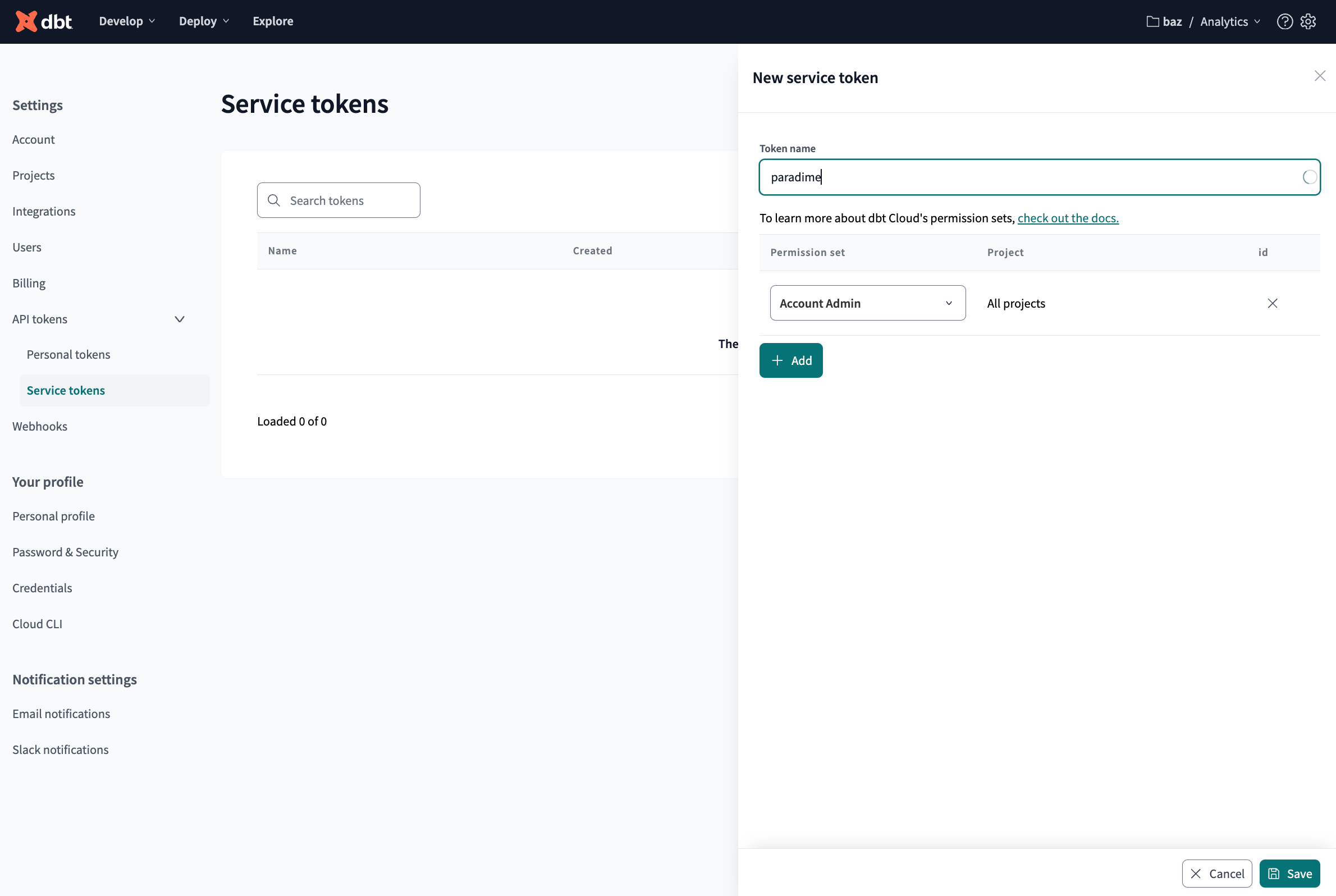
In dbt Cloud™, navigate to the account setting screen by clicking on the ⚙️ on the top-right of your screen and in the left panel select the Service Token option from the menu. Click on theNew Token option to create a new Service Token. Set paradime as token name and make sure to set:
- Permission set as
Account Admin - Project: select the dbt Cloud™ project that matches the Paradime workspace you are importing into
A dbt Cloud™ project maps to a Paradime workspace. The import brings every job the token can access into your current Paradime workspace. Scope the token (and the connection) to the single dbt Cloud™ project that corresponds to that workspace so you don’t pull another project’s jobs into the wrong place. To import several projects, repeat the connection from each matching Paradime workspace.
You will not be able to view this token again after generating it, so make sure to save it securely as we will need this in the next step to setup the integration.
Connect the dbt Cloud™ integration
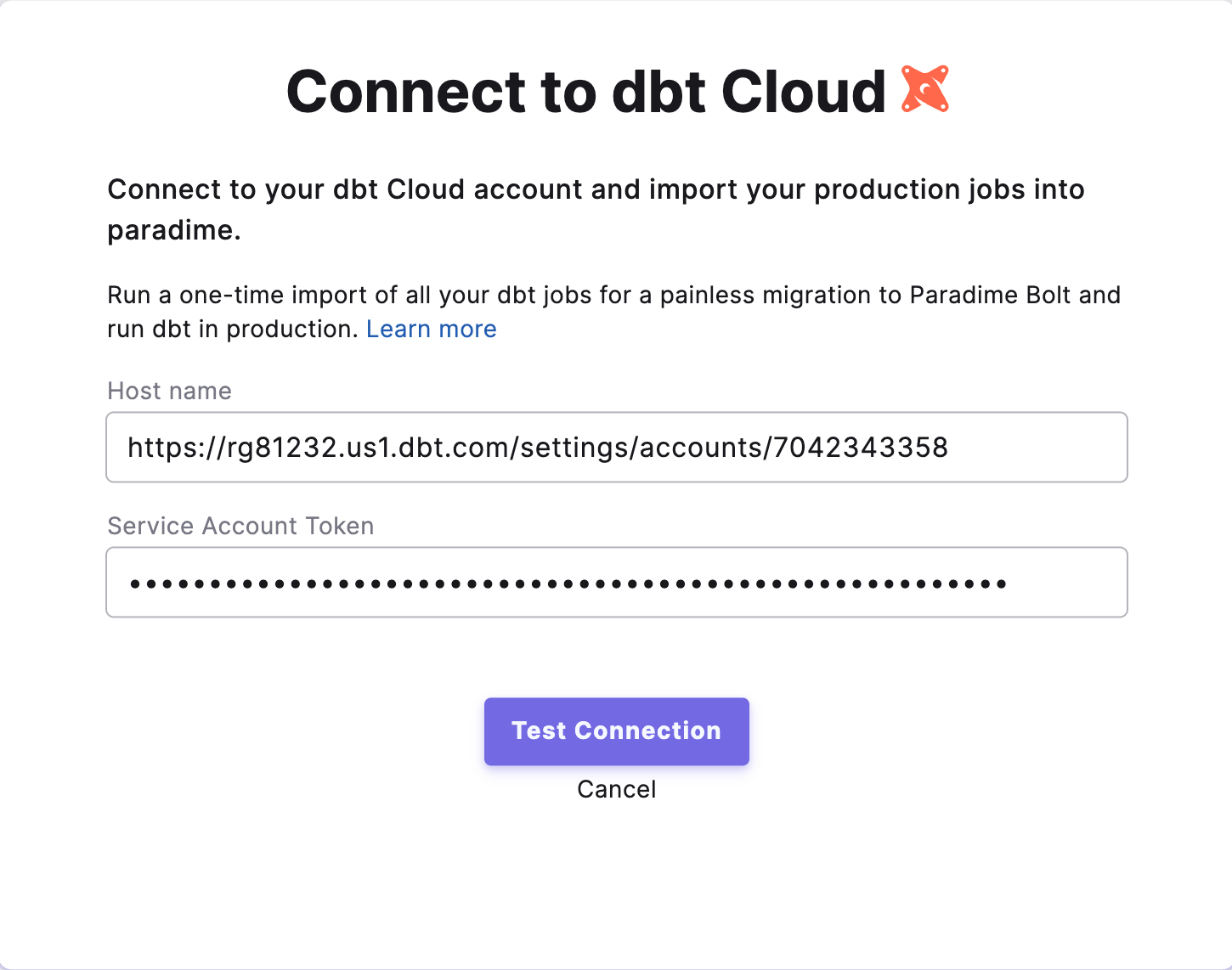
The dbt Cloud™ integration can be connected by a Paradime Admin. To enable the integration, in Paradime navigate to your Workspace Settings > Integrations, find the dbt Cloud™ integration and click Connect.- Host Name: simply copy your dbt Cloud™ url and paste it in this field, make sure to include the account as in the below example
- Service Account Token: enter the Token you have generated in the previous step in dbt Cloud™
View Imported dbt Cloud™ Jobs in Paradime
After the import is completed, Paradime will create new Bolt schedules using the dbt™️ Cloud Jobs’ configurations. You can now click on view imported jobs to view all the imported dbt™️ Cloud jobs in the Paradime Bolt UI. When ready, simply turn them on by updating the cron schedule configurations.Every imported schedule is created paused. Nothing runs automatically on import — you review each schedule and enable it from the Bolt UI when you’re ready.
How dbt Cloud™ Jobs are mapped to Bolt Schedules
Each dbt Cloud™ job is translated into a Bolt schedule. The table below shows how the job’s configuration is carried across.Trigger types
dbt Cloud™ jobs can run in several ways. Each trigger type maps to the equivalent Bolt concept:What is not imported
Some dbt Cloud™ settings have no Bolt equivalent, or are managed elsewhere in Paradime. These are intentionally left at their Paradime default:Re-importing jobs
What this means in practice:- Changes are not synced. If you change a job’s cron or commands in dbt Cloud™ and re-import, you get a new schedule alongside the old one — the original is not updated.
- Deletions are not detected. Jobs removed in dbt Cloud™ remain in Paradime.
- To avoid duplicates, delete the previously-imported schedules before re-importing.
Known caveats & limitations
- Schedules import paused. Review and enable each schedule from the Bolt UI when ready.
state:modified+commands need a deferral target. Because environment-level deferral isn’t imported, a command such asdbt build --select state:modified+is preserved but has nothing to compare against. Set the deferred schedule manually before enabling, or the run will fail / select nothing.- Duplicate job names. dbt Cloud™ allows multiple jobs to share a name. These import as separate schedules that display the same name (each has its own unique slug).
- A dbt Cloud™ project maps to a Paradime workspace. The import brings the jobs the token can access into your current workspace — it does not split projects into separate workspaces automatically. Scope the token to the project that matches the workspace, and repeat the import from each workspace to bring across multiple projects.
- On-completion triggers across projects/accounts. A schedule that runs on the completion of another job is only chained if the parent job is part of the same import. If the parent isn’t imported (for example, it lives in another project or account that wasn’t part of this import), the schedule is imported paused with no trigger.