# Bolt Schedules Environment Variables

Set up environment variables for [Bolt schedules](https://docs.paradime.io/app-help/documentation/bolt) (production jobs) to configure runtime settings, manage secrets, and customize your dbt™ and Python data pipelines in production.

{% hint style="warning" %}

#### Important Notes

* [Admin access](https://docs.paradime.io/app-help/documentation/settings/users) is required to add, edit, or remove these variables
* These variables are only available in [Bolt schedules](https://docs.paradime.io/app-help/documentation/bolt) (production jobs)
* For development environment variables, see [Code IDE Environment Variables](https://docs.paradime.io/app-help/documentation/settings/environment-variables/code-ide-env-variables)
  {% endhint %}

### Configuring Bolt Schedule Variables

* From any page in the Paradime application, Click **Settings**
* Navigate to **Workspaces > Environment Variables**
* In the Bolt Schedules section, click **Add New**
* Configure your variable:
  * Enter Key name
  * Enter Value
  * Click Save icon (💾)

{% @arcade/embed flowId="A8WSWDvVDm20rux5RJVG" url="<https://app.arcade.software/share/A8WSWDvVDm20rux5RJVG>" %}

{% hint style="info" %}
These variables will can be used in the [command settings](https://docs.paradime.io/app-help/documentation/bolt/creating-schedules/command-settings) of your [Bolt Schedules](https://docs.paradime.io/app-help/documentation/bolt)
{% endhint %}

***

### Bulk Upload Environment Variables

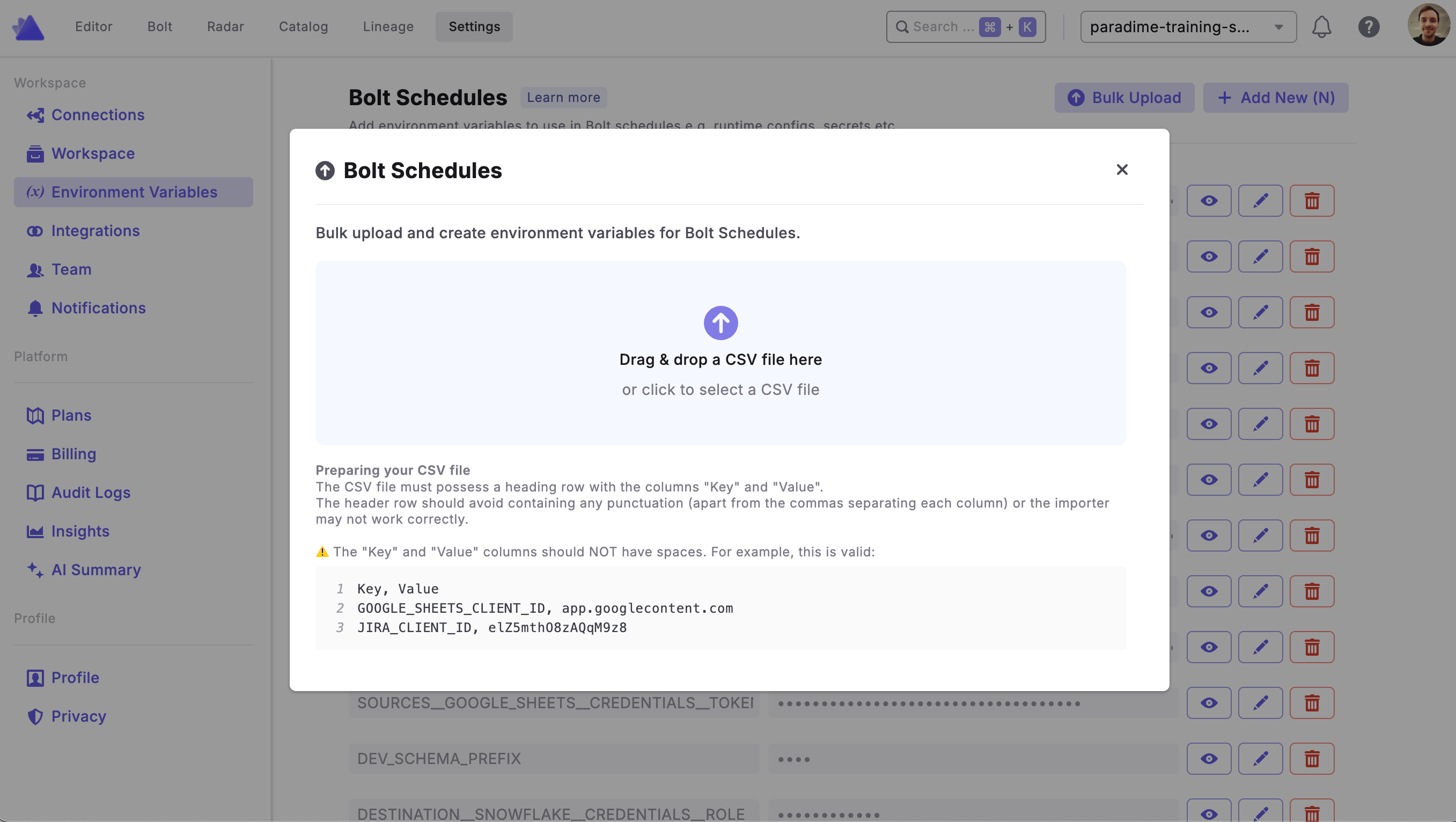
Instead of adding environment variables one at a time, you can upload multiple variables at once using a CSV file.

**To bulk upload variables:**

1. From any page in the Paradime application, click **Settings**
2. Navigate to **Workspaces > Environment Variables**
3. In the Bolt Schedules section, click **Bulk Upload**
4. Drag and drop your CSV file or click to select a file
5. Review and confirm the upload

<figure><img src="https://2337193041-files.gitbook.io/~/files/v0/b/gitbook-x-prod.appspot.com/o/spaces%2FHET0AD04uHMgdeLAjptq%2Fuploads%2FNrT5dzskBS6WYNXhwjK0%2Fimage.png?alt=media&#x26;token=cb6c3c59-31ae-46c3-850e-7ebbd09ac0e7" alt=""><figcaption></figcaption></figure>

**Preparing your CSV file**

The CSV file must have a header row with the columns "Key" and "Value". The header row should avoid containing any punctuation (apart from the commas separating each column) or the importer may not work correctly.

{% hint style="warning" %}
The "Key" and "Value" columns should NOT have spaces. Your CSV file should look like this:
{% endhint %}

**Example CSV format:**

| Key                        | Value                 |
| -------------------------- | --------------------- |
| GOOGLE\_SHEETS\_CLIENT\_ID | app.googlecontent.com |
| JIRA\_CLIENT\_ID           | e1Z5mthO8zAQqM9z8     |
| DEV\_SCHEMA\_PREFIX        | dev\_                 |

### Environment Variable Overrides at Schedule Level

While environment variables are configured globally at the workspace level, you may need different values for specific schedules. For example, you might want to use different database connections or parameter values for production versus staging schedules.

Paradime allows you to [**override environment variable values at the individual schedule level**](#environment-variable-overrides-at-schedule-level), giving you flexibility without duplicating your entire configuration.

#### How Overrides Work

* **Global defaults:** Variables configured here serve as the default values for all Bolt schedules
* **Schedule-level overrides:** Individual schedules can override these default values
* **Fallback behavior:** If no override is set for a schedule, it uses the global value configured here
* **Admin only:** Only workspace administrators can configure overrides at the schedule level